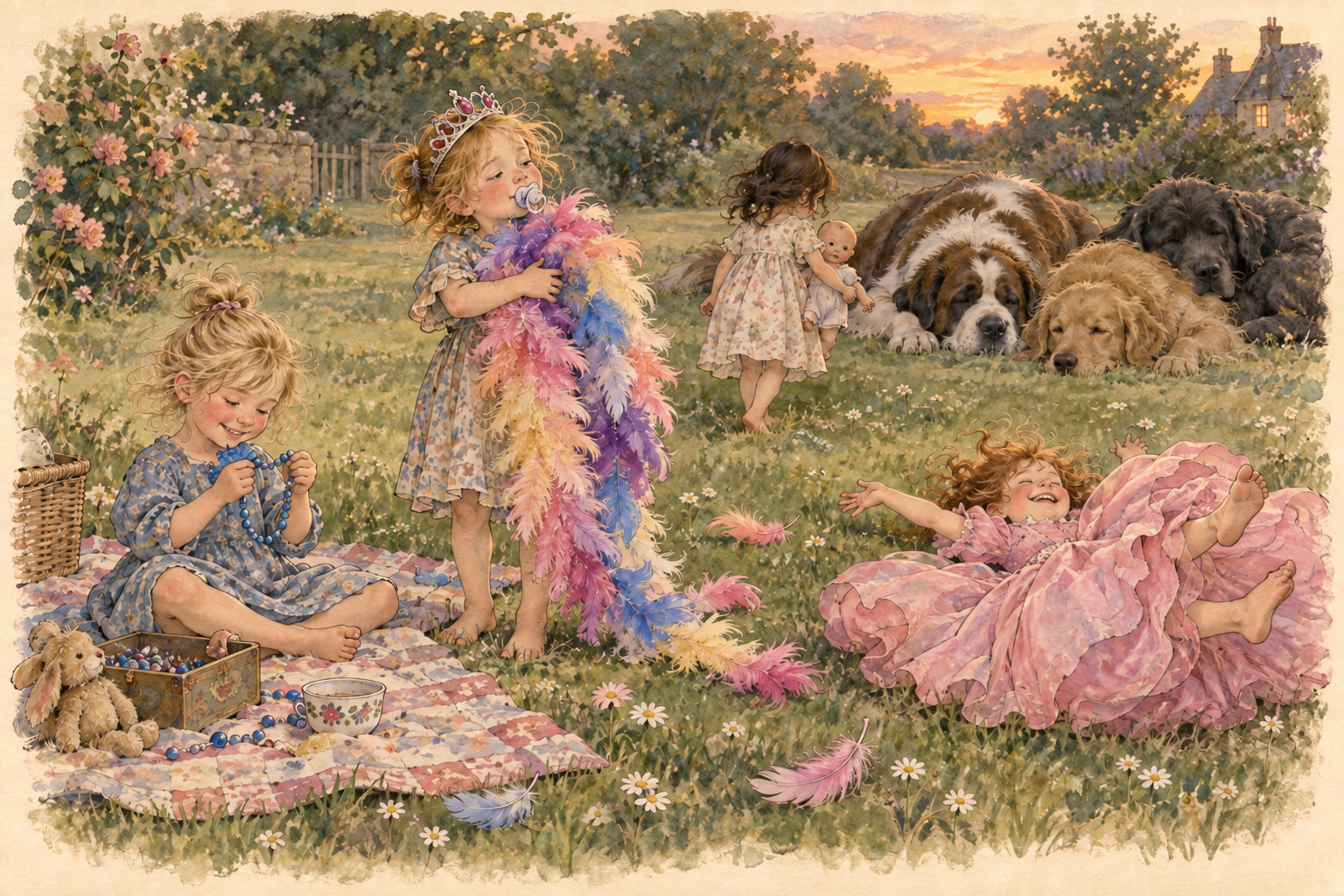
On a warm evening in the grass, a little girl had a blanket.
It was a very good blanket. Her mother had brought it, along with toys and snacks and all the things a person might need if she intended to remain exactly where she had been told to remain.
The girl did.
Around her sat her mother, her father, her grandmother, her grandfather, and an aunt. They were all completely obsessed with her. This seemed reasonable.
Then another little girl arrived. She did not have a blanket. She had curiosity.
She waved enthusiastically at the girl on the blanket, who waved enthusiastically back. For several glorious minutes, they were best friends. Then the newcomer noticed three enormous dogs.
The dogs looked terrifying. They were not. She needed to investigate immediately.
Her father intercepted her and returned her to the general vicinity of safety. She immediately reconsidered the dogs. Her father reconsidered her. Their evening developed a rhythm: the girl on the blanket remained on her blanket, and the explorer conducted unauthorized field research.
Their friendship had encountered its first scheduling difficulty.
Still, they shared one important thing. Neither believed in shoes.
A barefoot woman sitting nearby noticed this. She looked at the girl on the blanket, then at the explorer, then down at her own bare feet.
At last, a coalition.
Then the girl on the blanket hit the explorer with a ribbon.
Every adult in her enormous government paused. Her mother took the ribbon and brushed it against her cheek.
“See? Soft.”
The ribbon had been demilitarized. Peace resumed.
The girl settled back onto her blanket, and the explorer wandered away carrying a baby doll. But she returned, because the blanket contained something magnificent: a colorful feather boa.
The explorer wanted it. Its owner did not particularly want her to have it.
“Maybe she can just try it on,” her mother suggested.
The girl on the blanket considered the proposed licensing agreement. Then she smiled.
The explorer put on the boa and twirled.
The treaty held.
A girl in a tiara arrived. She also had a pacifier. Nobody found these facts contradictory.
Another girl arrived in a ball gown and promptly rolled in the grass. This was also correct.
They surveyed the blanket's established territory. By now its occupant was locally important. Even the musician knew her. When he left the stage for his break, he spotted her.
“My fan club!” he called.
She accepted this recognition with the composure of someone accustomed to having an entire multigenerational institution devoted to her existence.
Then commerce began.
The girl in the tiara possessed a blue beaded necklace. The girl on the blanket possessed the boa. Negotiations occurred. When they were finished, the girl in the tiara had the boa, and the girl on the blanket had the beads.
The barefoot woman recognized them immediately. They were the kind adults sometimes received at Mardi Gras for reasons nobody needed to explain to toddlers.
The girl on the blanket had successfully exchanged feather-based assets for titty currency.
The local economy was thriving.
The girl in the ball gown was still rolling in the grass. Her mother watched.
When the girl stood and twirled, her mother lifted her camera. The girl stopped, then rolled in the grass again.
No camera.
She stood and twirled.
Camera.
The girl considered this. Then she twirled again, and her mother raised the camera again.
The barefoot woman watched with interest. The girl had arrived wearing a ball gown and using it to roll in grass. Both activities had suited her very well. Only one was making it into the pictures.
She twirled once more. Her mother smiled behind the camera.
Perhaps tomorrow she would roll anyway.
And then—a boy. The first one.
His name, for purposes of field research, was Noah. He arrived with his father, who was neither the father attached to the blanket nor the father responsible for dog-related diplomatic incidents. A third father. The evening had become surprisingly difficult to administer.
Noah stood at the edge of a civilization already in progress.
There were ribbons and boas and beads and baby dolls and dogs and blankets and cameras and mothers and fathers and grandparents and music. Nobody was doing childhood the same way. And somehow, for brief stretches, they kept making room for one another anyway.
The blanket had begun as a place to stay put. Now other children kept coming to it. The boa had been borrowed, admired, returned, and traded. The ribbon had hurt someone before a mother reminded everyone it was soft. And a ball gown had proved perfectly adequate for rolling in the grass, although the photographs might not show that.
The barefoot woman looked down at her feet. She had brought neither a boa nor a crown, but she had qualified for the coalition without filling out a single form.
Across the field, the explorer was probably considering another unauthorized expedition. The girl in the tiara had acquired feathers. The girl in the ball gown twirled for the camera. Noah had some catching up to do.
And the girl on the blanket admired her new blue beads.
Those, she kept.
After all, a wise woman knows when she has made a good trade.